Tucked away ... all the way back on page 53 ... of McCalls Needlecraft (Fall-Winter 1953/54) is this small advertisement.
Send for Paula Bank's color card and fashion catalog. Order the finest yarn and knitting instructions from your home!. Send 50 cents for our Color Card of nationally known yarns, includes Fashion Catalog of our complete line of knitting patterns for the family.
The line that sent me on the Google search was "Paula Bank, nationally known knitting authority". Oh, and the idea that there might be a catalog out there that I've not seen. Well, Google and Newspaper.com resulted in nothing. But, I'm putting the post out here as a placeholder. AND ... perhaps one of you might have some of these patterns, or a catalog or know something more.
Thanks for dropping by,
Lorrie
Bits of Knitting and Crochet History collected and researched from vintage pattern books, newspapers and magazines. A fun look at old advertisements and tid-bits about the makers of threads, yarns, tools, pattern books and more.
Search This Blog
Sunday, November 26, 2017
Saturday, November 25, 2017
Royal Crest Yarn Contest
Through time, the various companies have employed a number of marketing strategies. There are, of course, the pattern books, kits and paks, state fair contests, fashion shows, representatives offering help in individual shops, etc. But this marketing ploy for this 'get to know us', came as a surprise.
This is a full half page add in the 1953-54 issue of McCalls Needlecraft. In case you can't read the small print, the gest is ... knit a piece with Royal Crest Yarn. And then finish this sentence ... I LIKE ROYAL CREST YARNS BECAUSE ..... in 25 words or less. Then, mail in your entry. Enter as often as you like.
There are 31 prizes ranging from a 1st prize of $500 down to $10.00. YOU CAN'T Lose, because whether you win a cash prize or not, you'll discover Royal Crest Yarns will save you money!
I did my typical Google, newspaper and book searches and came up with only a couple pictures. Apparently the yarn was not a big success. Here's three that I did find.
Thanks for dropping by.
This is a full half page add in the 1953-54 issue of McCalls Needlecraft. In case you can't read the small print, the gest is ... knit a piece with Royal Crest Yarn. And then finish this sentence ... I LIKE ROYAL CREST YARNS BECAUSE ..... in 25 words or less. Then, mail in your entry. Enter as often as you like.
There are 31 prizes ranging from a 1st prize of $500 down to $10.00. YOU CAN'T Lose, because whether you win a cash prize or not, you'll discover Royal Crest Yarns will save you money!
I did my typical Google, newspaper and book searches and came up with only a couple pictures. Apparently the yarn was not a big success. Here's three that I did find.
Royal Crest - Moonlight
Royal Crest - Petite Royal - 1 oz skeins, 75% Virgin Wool, 25% Rayon
Royal Crest - Royality Yarn
I'm sure I'll find more in other magazines as I go along and will come back here with any other details.
Thanks for dropping by.
Lorrie
Thursday, November 23, 2017
Nomotta Sterling Silver Bracelet Award
Tucked in the 1953-54 issue of McCalls Needlecraft is the full page Nomotta Advertisement.
Description: A Sterling Silver Knitting Needle Bangle Charm Bracelet, Nomotta, consisting of a knitting needle formed into a bangle bracelet and suspending a rectangular charm stamped with the Nomotta brand logo, the reverse inscribed in with German.
And, here's another advertisement from a 1955 magazine advising locations where you'll find this trained Nomotta knowledge.
And that's all. Now, I've set up alerts in the typical places, and one day, when I least expect it (hopefully), something will pop up! When that happens, I come back and update this post.
Thanks for dropping by.
Lorrie
"Sterling silver bracelet award for outstanding knowledge and proficiency! Earned by exceptionally gifted art needlework sales personnel after thorough individual testing. Now you can tell at a glance that the person proudly wearing this coveted award is unusually qualified to advise you in the selection of hand-knitting materials, and to guide you to the successful completion of the design of your choice".
Now, as you might image, this immediately prompted a multitude of questions in my mind. Like ....
How did one apply to be certified?
Was it an individual, or a needlework shop?
How was this 'award of excellence communicated to the customer?
How many of these awards were given out?
etc. etc. etc
I, of course, headed right over to a Google and then Newspapers.com figuring I'd find a gathering a marketing information for the bracelets. Nope. All I found was this auction image
Description: A Sterling Silver Knitting Needle Bangle Charm Bracelet, Nomotta, consisting of a knitting needle formed into a bangle bracelet and suspending a rectangular charm stamped with the Nomotta brand logo, the reverse inscribed in with German.
And, here's another advertisement from a 1955 magazine advising locations where you'll find this trained Nomotta knowledge.
And that's all. Now, I've set up alerts in the typical places, and one day, when I least expect it (hopefully), something will pop up! When that happens, I come back and update this post.
Thanks for dropping by.
Lorrie
Wednesday, November 22, 2017
Spinnerin Candour Yarn
In 1944, Spinnerin introduced their new Candour yarn to the market.
100% Virgin Wool, "a lightweight sports yarn" in 4 ply skeins. In this 1945 ad, notice that the Spinnerin Candour is significantly higher in cost than the other brands.
Here's another 1945 newspaper ad that details the range of colors. It also has a fun typo ... 40 oz skeins.
In this 1952 ad announce a packaging change "Now yours in the new 3-oz skein that reduces unit prices and eliminating overweight purchases!" This change would move Candour more in line with the 'then' market price.
In 1956, Spinnerin ran a campaign to recharge their Candour sales. This full page ad appeared in McCalls Needlecraft Magazine.
And was accompanied by release of a pattern book - Spinnerin Hand Knits in Candour, Volume 133. (It was also featured in Spinnerin Vol 177. I'm sure there are others as well; I'll add them as I come across). Not a lot, but I do have a few Spinnerin Candour patterns in the shop.
Candour yarn began it's decline in 1963 and in 1965 had disappeared from the retail marketplace.
Should I learn more about Spinnerin Candour, I'll drop back in and update this post.
Thanks for dropping by,
Lorrie
100% Virgin Wool, "a lightweight sports yarn" in 4 ply skeins. In this 1945 ad, notice that the Spinnerin Candour is significantly higher in cost than the other brands.
Here's another 1945 newspaper ad that details the range of colors. It also has a fun typo ... 40 oz skeins.
In this 1952 ad announce a packaging change "Now yours in the new 3-oz skein that reduces unit prices and eliminating overweight purchases!" This change would move Candour more in line with the 'then' market price.
In 1956, Spinnerin ran a campaign to recharge their Candour sales. This full page ad appeared in McCalls Needlecraft Magazine.
And was accompanied by release of a pattern book - Spinnerin Hand Knits in Candour, Volume 133. (It was also featured in Spinnerin Vol 177. I'm sure there are others as well; I'll add them as I come across). Not a lot, but I do have a few Spinnerin Candour patterns in the shop.
Candour yarn began it's decline in 1963 and in 1965 had disappeared from the retail marketplace.
Photo from Ebay seller Namukale6014
Should I learn more about Spinnerin Candour, I'll drop back in and update this post.
Thanks for dropping by,
Lorrie
Monday, November 20, 2017
Holland Windmill Imported Hand Knitting Yarns
Tucked onto page 11 of the Fall Winter 1953-54 issue of McCalls Needlework magazine with this wonderful color advertisement for Holland Windmill Imported Hand Knitting Yarns.
Now, I've processed a lot of patterns and had no recall of Holland Windmill in material listings.
I did discover, however, that I'd collected other advertisement for this company -- this one from 1952. Actually, I have several renditions of this same ad dating between 1953 to 1957. The only business difference is this ad shows Margo Trading as the importer, earlier ads showed Wool Trading Inc.
Now Holland Windmill Yarn was the product of Gebroeders, Van Wuk & Co of Leiden, Holland (you'll have to hit translate to read the Wikipedia). This is speculation on my part, but I'd suggest this product was marketed in the States between 1952 and 1957. A couple of the ads indicate there are free instructions, however, a search of internet-land renders nothing. There are also no traces of the yarn itself on Ebay, or a single mention over at Ravelry.
The company had a long run, starting up in 1795. In 1957 the company was merged and then later liquidated, coming to a complete demise in 1963.
I have quite a number of magazines that I've not been through, so, should I find any additional information, I'll come back and add to this post.
Thanks for dropping by,
Lorrie
Now, I've processed a lot of patterns and had no recall of Holland Windmill in material listings.
I did discover, however, that I'd collected other advertisement for this company -- this one from 1952. Actually, I have several renditions of this same ad dating between 1953 to 1957. The only business difference is this ad shows Margo Trading as the importer, earlier ads showed Wool Trading Inc.
Now Holland Windmill Yarn was the product of Gebroeders, Van Wuk & Co of Leiden, Holland (you'll have to hit translate to read the Wikipedia). This is speculation on my part, but I'd suggest this product was marketed in the States between 1952 and 1957. A couple of the ads indicate there are free instructions, however, a search of internet-land renders nothing. There are also no traces of the yarn itself on Ebay, or a single mention over at Ravelry.
The company had a long run, starting up in 1795. In 1957 the company was merged and then later liquidated, coming to a complete demise in 1963.
I have quite a number of magazines that I've not been through, so, should I find any additional information, I'll come back and add to this post.
Thanks for dropping by,
Lorrie
Thursday, November 16, 2017
Spinnerin Yarn Company
While researching Spinnerin Nylaine Yarns, I saw on a couple sites that indicated Spinnerin was in business from 1952 to the end of the 1970's. This raised my curiosity as I have a couple Spinnerin pattern books in my (pending) collection that date back to the 1940's. So, in bits and pieces, the investigation began.
Werner R. Leimgruber, was born in 1916 in Zurich, Switzerland. In 1939, at the age of 23, he was sent to the United States by Swiss Company. Wollgarn to start the Spinnerin Yarn Co. Mr. Leimgruber set up the business in New York (which is now part of the renowned Garment District).
First address on record - 230 Fifth Avenue, New York. This address served as office space.
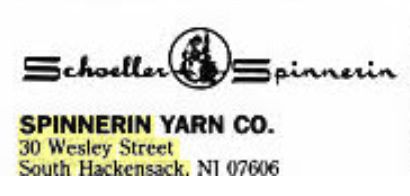
Spinnerin initially imports their yarns from Schoeller Textiles and for a time period shared a label. In 1945, Spinnerin were granted a approval for their Spinnerin logo (shown above).
The business is a niche, and they market it very well. Their products include not only yarn, but Ready Kits & Paks and a number of pattern books. In addition, Spinnerin was involved with knitting classes and fashion shows
In 1948, they finish building their South Hackensack plant. At this time, Spinnerin are still importing their yarn from various sources and dying within their plant. This would have been quite a large scale operation. Imagine here, receiving the yarns, dyeing, packaging, storing, distributing to needlework stores, etc. etc. etc.
Their operation grew to over 300 employees. By the late 1970's, Spinnerin began a business transition. Hook rug yarns and kits were introduced, as well as crewel patterns and materials. They also entered commercial supply of threads and yarns to garment manufacturers.
By the mid 1980's the company all yarn and thread advertisements end, signaling the end of Spinnerin Yarn as a niche market supplying needlecrafts.
The company evolves into Spinnerin Dye, LLC, where it appears to operate until 2016.
And then .... well, I don't know. There are a large number of holes to this story that I'd love to update, but have been unable to find any contact. The website for Spinnerin Dye is non-functional, the telephone number is disconnected and the plant property is up for sale.
And there, this piece ends. Now, I've added a Google alert and will update this post should new information arise. AND, as always, if you have information to share, I'd love to hear from you.
Thanks for dropping by
Lorrie
Werner R. Leimgruber, was born in 1916 in Zurich, Switzerland. In 1939, at the age of 23, he was sent to the United States by Swiss Company. Wollgarn to start the Spinnerin Yarn Co. Mr. Leimgruber set up the business in New York (which is now part of the renowned Garment District).
First address on record - 230 Fifth Avenue, New York. This address served as office space.
They had a second address at 1407 Broadway, New York, which served their receiving, repacking and shipping space needs.
Spinnerin initially imports their yarns from Schoeller Textiles and for a time period shared a label. In 1945, Spinnerin were granted a approval for their Spinnerin logo (shown above).
The business is a niche, and they market it very well. Their products include not only yarn, but Ready Kits & Paks and a number of pattern books. In addition, Spinnerin was involved with knitting classes and fashion shows
In 1948, they finish building their South Hackensack plant. At this time, Spinnerin are still importing their yarn from various sources and dying within their plant. This would have been quite a large scale operation. Imagine here, receiving the yarns, dyeing, packaging, storing, distributing to needlework stores, etc. etc. etc.
Their operation grew to over 300 employees. By the late 1970's, Spinnerin began a business transition. Hook rug yarns and kits were introduced, as well as crewel patterns and materials. They also entered commercial supply of threads and yarns to garment manufacturers.
By the mid 1980's the company all yarn and thread advertisements end, signaling the end of Spinnerin Yarn as a niche market supplying needlecrafts.
The company evolves into Spinnerin Dye, LLC, where it appears to operate until 2016.
And then .... well, I don't know. There are a large number of holes to this story that I'd love to update, but have been unable to find any contact. The website for Spinnerin Dye is non-functional, the telephone number is disconnected and the plant property is up for sale.
And there, this piece ends. Now, I've added a Google alert and will update this post should new information arise. AND, as always, if you have information to share, I'd love to hear from you.
Thanks for dropping by
Lorrie
Wednesday, November 15, 2017
Crochet Angora Cape Pattern Story, Alice Brooks 6135
Here's a fun story (or at least, I think so). There is no way that I can tell the story better than the March 29, 1964 Shreveport Times newspaper article, so I'm going to share it excerpts. (If you have the time, I do recommend reading the whole article).
Mrs Gleason came across a newspaper clipping for mail order pattern Alice Brooks 6135, Crocheted Angora Cape, in her late Mother-in-Law' belongings. The pattern was just what she was looking for to make for her grand daughter, so she mailed away for the pattern.
The Shreveport Times researched and identified the pattern back to their February 14, 1939 issue. Ultimately, the request was sent to New York for fulfillment. The pattern had been stored on microfilm, which has deteriorated. Several experts carefully restored the pattern and sent it to the requester.
A very happy Mrs. Gleason crocheted a cape for each of her two grand daughters.
P.s. There's also some very interesting Mail Order Pattern history in here.
Thanks for dropping by,
Lorrie
Mrs Gleason came across a newspaper clipping for mail order pattern Alice Brooks 6135, Crocheted Angora Cape, in her late Mother-in-Law' belongings. The pattern was just what she was looking for to make for her grand daughter, so she mailed away for the pattern.
The Shreveport Times researched and identified the pattern back to their February 14, 1939 issue. Ultimately, the request was sent to New York for fulfillment. The pattern had been stored on microfilm, which has deteriorated. Several experts carefully restored the pattern and sent it to the requester.
A very happy Mrs. Gleason crocheted a cape for each of her two grand daughters.
P.s. There's also some very interesting Mail Order Pattern history in here.
Thanks for dropping by,
Lorrie
Subscribe to:
Posts (Atom)