Search This Blog

Monday, July 9, 2018

Supra Mohair Yarn, Bear Brand, Fleishers, Bucilla

1960 -- It was a grand year in the yarn market; another mohair was introduced -- Supra Mohair.  -


Lovely Supra Mohair, an exquisite, soft brushed yarn imported from Italy in a beautiful range of colors.  For dress sweaters and jackets in 19 hues.   The imported yarn was branded by Bernard Ullman under all three of the associated brands - Bear Brand, Botany and Fleishers.


1-3/8 oz skeins (100% Goat Mohair in 80 yard balls)
Needle Sizes 8 to 10-1/2
Bulky, 12 ply
This is a great comparison photo, which I should be helpful in searching out replacement yarn.  

The yarn was introduced at $1.79 per ball.  As was typical however, it was available 'on sale' at most independent yarn shops.


In the typical fashion of Bernhard Ullman, free pattern promotions were splashed across the country.  This concept was, of course, a dual win for both the brand, as well as the local shops who supplied the materials to interested knitters.  Numerous ads appeared for each of the represented brands - Botany, Bear Brand and Fleishers.  Each with a separate pattern selections.


Here's another under the Fleishers name.   The hat, on the left, was also published in Bernhard Pattern Book 92 -- Hats, Hats, Hats.

In the Northwestern markets, Supra Mohair Yarn was also marketed under the Bucilla label.  (Bucilla being the alternate company name of Bernhard Ullman).

Although Bernhard Ullman did not issue a pattern book solely devoted to the Supra Mohair yarn, it did make an appearance in several of their issues.    Patterns were also featured in a couple of the Needlework magazines.  When I come across them again, I'll update this post.  (I always love the old magazine ads).

And on it continued ... sales announcements from individual shop owners coupled with newspaper pattern promotions .... until 1970, when the big slash sales took place to reduce the final inventory levels. 

A good yarn .. yep.  A supply of good vintage patterns out there ... yep.  There are, of course, a few in the shop, should you care to browse.    For a replacement yarn, with the above specs, try Google-ing something like 12-ply mohair yarn, and select one that meets the gauge of your pattern. 

Thanks for dropping by,

Friday, July 6, 2018

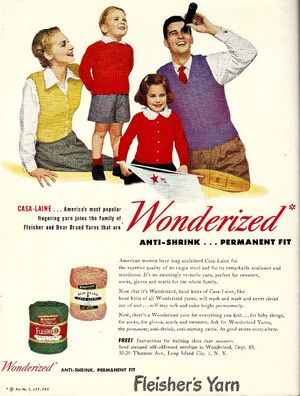
Casa-Laine Yarn, Fleishers and Bear Brand

The Casa-Laine Yarn takes us way back to 1943 .... it was from the Silent Generation, you might say.  The yarn was introduced in early 1943 to a fairly large market across the United States.

Casa-Laine was marketed under both the Bear Brand and Fleishers label.   Now one could ask why same yarn under two names?   I, of course, do not know, but would guess this would be to catch preference buyers ... some might have allegiance to Fleishers or Bear Brand?  Note:  Some patterns also indicate that the yarn was marketed under the Bucilla Brand name as well.


100% All-Virgin Wool Sports Yarn -- 250 yards in 2-oz skeins -- 4 ply


By 1950, Casa-Laine now 'proudly' bears the coveted Good Housekeeping Seal of Approval.  As one would expect, the price is slowly inching up.

Photo from VintageYarnWiki
The yarn was also featured in full-page advertisements in a number of needlework magazines into the early 1960's. (I'm sure  I'll find more when I  start working my way through the magazine collection and will add them).  This yarn, no-doubt, was also featured in a number of pattern books by both Fleishers and Bear Brand.

And, sales and the newspaper promotions continued on into 1968.   And then, it was all over; for the next two years the only  references to  Casa-Laine are discounted and clearance sales to deplete the remaining shop inventories and completely disappeared by 1970.

The Casa-Laine brand had a good and long life ... 1949 to 1968.   It was a good solid product and I'm sure there are many interesting  patterns out there, there are deserving of a knit .... There are, of course, several in the shop, should you care to browse

For a substitute, a nice 4-ply Sports Yarn that meets the gauge of your pattern should do it ... you might  want to consider a fingering or sweater and sock yarn, as well. 

Ok, back to work.   Thanks for dropping by.

Sunday, July 1, 2018

Spinnerin Duet Yarn

Spinnerin, a fine dress yarn, made its debut in mid-1951.  The yarn was made in Switzerland for Spinnerin marketing.

78% all Virgin Wool and 22% Rayon, sold in 120 yard, 1 ounce skeins.   Skeins were purchased individually, or by the box.  


Advertising was completed in a limited market - Pennsylvania - and not spreading into other markets for several years.  

I this 1965 advertisement, we see a rather significant change to the Duet blend -- now 38% Wool and 62% Nylon, as well as a  price drop. 


Spinnerin frequently promoted the yarns in mail order give-away's through the Judy Love newspaper column.  In this case, an attractive two-piece suit with crocheted shell.  

Spinnerin did not publish any pattern books solely dedicated to their Spinnerin Duet yarn, however, the  yarn was included in several of the pattern book releases between 1955 and 1967.  


Sales lightend up as, moving into the 70's, the average woman no longer knit their wardrobes, thus reducing the demand for dress yarns.   The yarn made it's last appearances  in 1971.  

There are a couple patterns in the shop.   I'm sure there will be more when I start working my way through the Spinnerin pattern books in my collection.   As far as a substitute ... I can't say other than the typical ... a lightweight plied yarn that meets the gauge of your particular pattern.    

Thanks for dropping by, 
Lorrie

Wednesday, May 30, 2018

Laura Wheeler, Genius of Needlecraft

I was wandering around in Newspapers.com searching out pattern notations, when I came across this interesting article from June 8, 1945.   The  article, titled 'Laura Wheeler, Genius of Needlecraft' was written by Helen Dudnick.    I'm reprinting the article as it was written.


Thursday, May 24, 2018

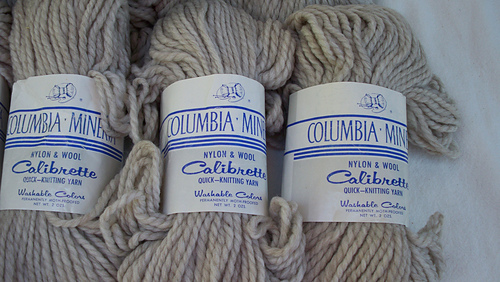
Columbia Minerva Calibar Yarn

And, in 1957 --- another brand introduction from Columbia Minerva --- Calibar Quick Knitting Yarn!

A soft, fluffy, 100% Virgin Wool yarn spun especially for jiffy knit garments.  4-ply in 2 oz skeins, 70 yards

It was introduced with very little advertising fanfare in only 7 states during it's lifespan.  This was at the start of the bulky yarn phase, and, perhaps Columbia Minerva believed the yarn would stand on it's name alone.   The majority of their promotion came from the pattern aspect ... versus price. 

1958 Newspaper promotion:  "A jaunty jacket for junior miss to enjoy knitting herself Is a simple design that's perfect over a school or party dress, as a topper for slacks; or over the new tapered pants. It is a perky bulky knit with fashionably smart brass buttons and is made in a ribbed pattern design that work up quickly. The combination of Columbia - Minerva's Calibar yarn and the easy stitch make it possible to complete the jacket in less than a week. To order free knitting instructions for this jacket, send a stamped, self-addressed envelope. Ask for Pattern No. 357. Address Pattern Dept., The News, P. O. Box 1912, Grand Central Station, New York 17, N. Y.

1960 Newspaper Promotion:  "Knitted coat is a natural for topping your favorite spring clothes from a sheath to a flat-pleated skirt. The model shown is three quarter length, with slimming lines and a looped yarn collar. It is a quick knit with Columbia-Minerva Calibar or Calibrette Yarn using size 8 and 13 needles. To order free knitting instructions for this coat, send a stamped. self-addresed envelope for pattern No. 462. Address Pattern Dept., THE NEWS, P. 0. Box 1912. Grand Central Station, New York 17, N. Y.

Here, the Columbia Minerva Calibrette yarn is a designated substitute.  The primary difference is Calibrette is a wool/nylon blend, versus 100% wool.


The Calibar yarn was also promoted in Columbia Minerva Book No 732, Quick Hand Knits.  This pattern book is featured in a post in the Shoptalk Blog.  


And, the very last promotion was a lone advertisement offering the yarn at $0.49/skein.   This is obviously a close out price - original introduction was $0.89/skein.  And with that, Columbia Minerva Calibar yarn became a discontinued product.   The Calibrette yarn was discontinued in 1963.  

Now, there are a number if interesting patterns that call for these yarn.  I have a small number of these patterns in the shop, should you care to browse.  Should you decide to create one of these Jiffy Knits for yourself, simple choose a bulky 4-ply yarn that meets the stitch gauge of your pattern. 

Thanks for dropping by,

Monday, May 7, 2018

Anne Cabot Needlework Column

The syndicated Anne Cabot Needlework column was a part of the Readers Mail family, along with the other two well known mail order pattern names - Alice Brooks and Laura Wheeler.

Now, Anne Cabot Needlework Corner is a fictional name for the column, to give it a 'personal' feel.  So keep this in mind as you read the article. 

Now, I don't usually do a 'mostly' in full quote of a newspaper article, but, in this case I'm making an exception.
Quote:  "This story will introduce to our readers Anne Cabot, author of the sparkling new Home Arts feature - Anne Cabot's Needlework Corner.

Today a national expert who tells women folk how to use needle and thread, wool and cotton yarn, new fabrics and colored ribbons to make lovely things for themselves and their homes.  Anne Cabot found her first needlework corner at her grandmothers knee near an old base burner in a farm sitting room.  Before she was 10 she could weave a darn on a sock that was a work of needlecraft art.

This alert, widely traveled, friendly American woman, successful wife and mother, had judged National Needlecraft contests year after year and has visited county and state fair needlecraft exhibitions all over the country.  She has lectured between women' clubs, conducted University classes for  women, sought new designs and exciting color ideas among paintings in the great European art galleries, and has sat beside the famous lace makers of  Bruges and Belgium, learning their secrets.

She has taken tea and gossiped with crocheters in quaint continental towns, learning from them some of the crafts she now tells women about in her new and exciting daily column.

Mrs. Cabot was born in a small city near the Great Lakes, raised largely on her grandmothers farm and educated at a normal school.  After teaching at 19, in old fashioned country schools, she began to travel and study abroad and in the United States and ultimately became one of the outstanding judges of needlecraft.

Mrs. Cabot says the old fashioned custom of crocheting or stitching gave grace and repose to a woman' appearance as she sat by the sitting room lamp, and she has been happy to see the revival of that custom.  Invited everywhere because of her personal charm, and wide reputation, she usually takes along some piece of needlecraft.

In Mrs. Cabot you have a new friend, one who understands what you want in needlecraft and can tell you how to make it.  Look for 'Anne Cabot's Needlecraft Corner'  every day"    End Quote

Now, this just goes to prove, that just because you read it in the newspaper, doesn't mean it's true!

Oh, and before I go back to work, what was the very first Anne Cabot pattern advertised?   Well ....


Thanks for dropping by,

Dawn Baby Yarn, American Thread

Dawn Baby Yarn, from the American Thread Brand ....

(photo from collection of  Ravelry member)
Dawn Baby Yarn - 100% Wool, 3 ply, Art W45 in white, pastels and multi-color  skeins


This American Thread Yarn was introduced to the market in late 1946 with very little fanfare .. just a simple yarn shop advertisement in Lubbock, TX only.  This would imply that American Thread did not finance the introduction with a 'typical' major  markets promotion.

The yarn started at 1-oz skeins; by  the  mid 1960's, it was expanded to include 2-oz skeins as well.

Other than a limited number of sale ads (like  above), the only other promotion was this 1961 Free 'mail-away' offer for an adorable baby set.  I'm sure the baby  yarn was featured in an American Thread pattern book, or two, however, I've not yet identified them.   (Perhaps you know?)

In 1977, the yarn disappeared from shops with as little fanfare as it was introduced in 1946.  A random guess, on my part, would be the growing of popularity of the Dawn Wintuk Baby Yarn -- which was a nylon blend, led the sales for  American Thread in baby yarn.

And, that's all I know.   If you have a design that you'd like to try, substitute a lightweight baby yarn that meets the  gauge of of your pattern ... be it 100% wool, or one of the  marvelous blends.

If you know more .... Please share. 
Thanks for dropping by,