Search This Blog

Friday, April 2, 2021

Crochet Baskets Pattern Numbers, Laura Wheeler 619

 I was processing Laura Wheeler 619 for two crocheted baskets, when I realized I already had a basket pattern numbered Design 619.   But, this post is really about the pattern numbers, versus the pattern themselves.   Let's go ahead anyway, and take a look at the two patterns.  


This is the Oldest of the two Design 619 patterns, dated 1957.   It's for a pineapple basket that measures 7-1/2 inches. 

The second basket pattern, dated 1976, also Design 619, are crocheted in two slightly different styles.  These baskets feature a handle and are also 7-1/2 inches in diameter.

So, why did Needlecraft Services give two different basket designs the same number.   Well, I course, do not know for sure, however, I'd venture to say "they" (whoever the numbering person may have been), gave it a thought.   

I keep a rather extensive spread sheet of these Mail Order Design patterns (knit, filet, crochet only) and have come to realize that an individual pattern number was reused multiple times.    In the case of (Laura Wheeler) Design 619, 

1943 -  Filet Crochet Rose Chair Set
1945 -  Crochet Waffle Weave Hats
1947 -  Crochet Two Color Oval Rug
1949  - Embroidered Sacred Heart Panel
1957 -  Crochet Pineapple Planter
1958 -  Crochet Pineapple Doilies
1963 -  Crochet Afghan Squares
1972 -  Embroidered Vest Sewing Pattern 
1976 -  Crochet Baskets in two styles
1978 -  Knitted Hip Length Jacket

See what I mean?   In this case, the pattern name Design 619 was used 10 times.   When I research an individual pattern number, I typically find there will be between 6 and 12 repeats.   The highest duplicator among doily patterns - because there were so many of them.     I continue to study the pattern number sets to determine if there is some hidden logic.   So far, I have not, BUT I'm waiting for the AHA moment.  

Both of the Basket patterns are in the shop, should you be interested.   Just click on the links below the picture.    

Time for me to get back to work (I'm quilting today!).   Thanks for dropping by. 

Monday, March 1, 2021

Anne Cabot Introductory Pattern Offer

How about a bit of Anne Cabot trivia?   The brand of Anne Cabot, often referred to as Mrs. Anne Cabot's Needlecraft Corner, entered the pattern market in March 1941 with an assortment of sewing, crochet and embroidery patterns.   This was a syndicated column that began in Iola Kansas and quickly spread across major metropolitan areas.  

The Anne Cabot brand had touch competition from the likes of the Alice Brooks and Laura Wheeler brands, which also were advertising Mail Order Patterns that were established in 1939 and had a strong customer following.   

In an attempt to gain following, Anne Cabot offered a coupon promotion on their individual patterns. 


This SPECIAL INTRODUCTORY OFFER was printed in the bottom corner of the individual patterns.   The concept being, purchase five patterns and get one free with an expiration of December 1st, 1941.  In this particular instance, the pattern was a nursery rug with bunny cross stitch marketed under No 5228.  

Simply collect the coupons printed on your purchased patterns and mail  in, with a note showing your requested pattern, to the New York city address.    The value of this free pattern ... 10 cents, which was the cost of the patterns purchased in this 1941 time frame.    

To date, among the mail order needlework pattern suppliers, this is the 'Promotional Sale' that I've seen.   I wouldn't be surprised, however, if others show up.  

Thanks for dropping, 
Lorrie 

Tuesday, February 16, 2021

Crochet Medallion Pattern Story, Alice Brooks 6406

In processing the Mail Order patterns, I've seen this particular story repeat many times.  I thought I'd take a couple minutes and share it with you.    The centerpiece of the story .... 

Crochet Star Medallion Pattern Design 6406

Alice Brooks 6406 - Crocheted Medallion - 5 or 8 inches

This particular story takes us back to 1939.   Every couple days in newspapers across the country, an advertisement for a pattern would be printed in the women's section.  The advertisement were written to resemble an article, a woman' feature.  

Medallion Crochet Pattern Newspaper Ad

Such as this article, which appeared in the Denver, CO paper on June 8, 1939.   Miss Doris Biggar, read the ad, and decided to purchase the pattern.    She mailed her letter, along with 10 cents to the newspaper's department.   On the bottom of the pattern clipping, she wrote in the date she mailed for the pattern.  (I frequently find this in the Mail Order patterns - the pattern and clipping inside the original mailing envelope).  

A couple weeks go by, and the pattern is returned.   (Note, the envelope reads mailed from the Denver Post, however, the Post Office stamp reads San Francisco).  

Now, what happens next I cannot say.  Did Miss Biggar stitch this medallion?  Did she make a tablecloth or a bedspread?  Did she later tuck the pattern away, or give it to a friend?  That part is a mystery.   What I do know, is someone came across this pattern, probably at an Estate sale, listed it as a lot on Ebay, and I purchased it ..... some 81 years later.  

And now, I've processed it into PDF format and listed in my shop.   It's been carefully preserved in a sleeve and store away with all the others.   And what will happen to?   Well, that I cannot say.  Perhaps, before I die, I'll donate them, or someone will take over the shop and continue to preserve, or perhaps they'll end up at another Estate sale 20 or 30 years from now.   

If you have these mail order patterns or catalogs, tucked away in drawers, I'd truly appreciate your sharing them.   I am trying to create a historical collection of these little 'Bits of History'.  

Thanks for dropping by, 
Lorrie  

Sunday, January 10, 2021

Dritz Luxury Chennile Yarn

 This afternoon I was updating one of my old patterns, which included Dritz Luxury Chenille and decided to take a bit of time to learn more about this yarn.    Here's what I learned . . . 

Dritz Luxury Chenille - A Velvety yarn in colors, or combinations, for personal accessories.   The yarn, containing 72 yards per skein, is 80% Rayon (for luster) and 20% cotton (for additional strength).   


Luxury Chenille was introduced to the market in 1950 with the first newspaper promotion advertisement appearing in May.   The introductory price was 49 cents/skein.  The yarn was first sold at 49 cents, no doubt to span interest, and went to the regular price of 79 cents within a month.


In 1951, Dritz issued a pattern book, and a promotion blitz on four of their popular yarns on the market. 

In these time periods, the yarn makers typically published pattern books to promote their product.  Dritz did not follow this course.   Instead, they printed pattern mail away offers in newspapers and published their patterns in the monthly magazines, such as McCalls Needlecraft and Modern Knitting.  

Dritz also ran advertisements (in the format of an actual newspaper article) for mail order patterns for  featuring their yarn.   In this case, the pattern(s) include Dritz Luxury Yarn.   The majority of their patterns were distributed through magazines.   Most of the patterns in my shop coming from Modern Knitting and McCalls Needlecraft. 

The Luxury Chenille peaked at 85 cents a skein, and at it's final appearance in 1957 dropped down to 50 cents.   Why it was discontinued ... well, I of course, do not know.   However, this was a novelty yarn for the time period and it's profitability was most likely of issue.   

There are many vintage patterns calling for Dritz Luxury Yarn.   I have a number in my shop, as well as others out there in internet land.  So, what do you substitute?   Any chunky chenille yarn that meets the pattern stitch gauge will fit the bill.   Debra, over at Vintage Crafts suggests Lion Brand Chenille Yarn.  

Okay, it's time for a break and then I'll get back to pattern processing.   
Thanks for dropping by,  Lorrie

Tuesday, November 17, 2020

Spinnerin Touchdown Yarn

I was working on a pattern last night that called for Spinnerin Touchdown Yarn.  Out of curiosity, I slipped over to Google to see what it was.   Well, sometimes, these vintage yarns can be quite challenging, which is the case with this one.  Google results, other than a couple pattern references, had nothing.   That means, not a single skein for sale on Ebay or Etsy, a blog post showing off a stash., nor a single detail page at Ravelry.  Nothing.  Now, the challenge was on.  I headed right over to Newspaper.com.   

The yarn was introduced to the market in late 1948.


This 1949 advertisements tells us, it's 100% wool in a variety of colors and white.  

This 1950 advertisement advises it's tough, lightly spun and soft and springy to the touch in a range of 36 colors, including tweed. 

This 1951 advertisement, doesn't shed any additional information, but it's the closest I could find to an actual picture of the yarn! 

And this 1952 advertisement sheds a few more details.  'Fine hard twist, 4-ply virgin wool yarn, Non-shrink, moth-proof.  

The Spinnerin Touchdown Yarn stayed active for several years, disappearing from the active market in 1959.  

There are a number of vintage patterns out there in internet land that have 'worthy' all over them.  I have a several in the shop as well.  Should you decide to knit one, let's suggest as a substitute - a 4-ply, 100% wool fingering or sock yarn that meets the pattern stitch of your particular pattern.   

I've set up a Google alert to search for additional information to update this post.   Should you have pictures, or know more, please let me know!

Thanks for dropping by,  Lorrie  

Friday, August 7, 2020

Filet Crochet Deer Pattern, Mail Order

As I've indicated many times, I consider each one of these mail order patterns a small bit of needlework history.   And, my fascination continues grow.   Each time I figure one bit out, additional questions arise.  

Filet Crochet Deer Pattern No 334-N

I processed this sweet Filet Crochet Fawn Chair Set pattern yesterday - No 334-N.   I've seen the 'N' designation on mail orders a couple other times, but had not taken the time to investigate.   Now is the time .... 


This newspaper advertisement, for the exact same pattern, was released as Anne Cabot 2387 in February and March, 1953, primarily in the Northeast.  The Anne Cabot patterns in the 2000 number series tie back to Needlework Bureau patterns marketed by that name, as well as Peggy Roberts.  I've not (yet) found the advertisement for the initial release.  I have a number of the Needlework Bureau catalogs to be processed, perhaps I'll find it there.  

Filet Chair Set No 334-N from Philadelphia Inquirer

 This newspaper ad takes us to September of 1960 and was published in the Philadelphia Inquirer newspaper.   I've seen the 'N' designation before, but have further study to determine if this was used solely by the Inquirer, or if it simply ties it to the original pattern by Needlework Bureau.  I also found 9/1960 advertisement showing it released as Audrey Lane in Oklahoma.  

Typically the pattern numbers did not change when rebranded.   For example, the American Weekly designs were all Alice Brooks Designs.  I'm sure I'll find more references to rebranding of numbers.

See what I mean?   The more I learn, the more I wonder about.  Perhaps you know something about this mail order history and can help fill my gaps?  

But, back to the pattern itself .... It's a simple filet crochet design that can be created in two sizes depending upon materials used.  I have a number of filet crochet deer patterns in the shop, this is, however, the first time I've seen one that represents a fawn alone. 

Thanks for dropping by, 
Lorrie

Thursday, June 25, 2020

Mayfair Needle Art Designs, Mail Order Patterns

Next up in my stack of Mail Order Patterns to process is a crochet pattern branded as Mayfair Needle-Art Design.  I recalled I already had one Mayfair pattern, however, had not yet taken the time to learn more.  Well, now is the time!
The official name of the pattern line - Mayfair Needle-Art Design.   In the newspaper clippings they simply branded 'by Mayfair'.  They marketed a line of sewing, knitting and crochet patterns in 'The Tribune' franchise of newspapers across 17 states. The advertisement promotions appeared bi-weekly in the Womens Pages.   The ads first appeared in April 1936 and ran through October, 1937, then disappeared .... no more 'by Mayfair' tag lines.   
There were approximately 140 marketed, all three digit numbers ranging between 120 and 350.  Now this number range implies there may have been more patterns.  If so, I've not found them!  There was also no sequence to how they appeared, one week 220, the next 135.   
I've just two of these patterns .... 

This blouse an unusual factor - perhaps consistent with it's age.  It was ordered by size (32 to 38), and came with tissue patterns for blocking purposes. 

I looked to see who preceded Mayfair Arts in the Tribune publications.   Well, for sewing patterns, it was Household Arts.  At that time, Household Arts did not market knit or crochet Designs. Perhaps, Mayfair was, for a short time period, a part of Household Arts.  

And who followed Mayfair Needle Arts?  Household Arts, of course, under the name of Alice Brooks. 

And, that's all I (currently) know about Mayfair.   Should you know more, or perhaps some of these patterns in your collection that you would be willing to share, I'd be most appreciative.   I'm trying to create a directory of mail order designs for that 'Bits of History' concept. 

Thanks for dropping by,   Lorrie

Monday, June 8, 2020

Vintage Crochet Cape Pattern, Alice Brooks 5360

Each day I strive to process one or two mail order patterns for the shop.   Today, at the top of the pile (or, actually, at the front of the container) was Design 5360, which seemed as good as any a place to start.   Now, at this point, I could call this pattern .... how I spent a good portion of the day.

This pattern is best described as fragile .... as it should be ... going all the way back to 1936.


Fortunately, I'd scanned this pattern back in 2014, before it became quite so fragile.   (Yes, sometimes it takes me a long time to get around to a pattern - I've several hundred waiting).   Still, it needed taped back together at the folds for the checking process.   An interesting note about this Alice Brooks Design pattern is it is written entirely in caps (which made it a real bugger to check).   I do not recall seeing this in any others.     A second interesting factor is the pattern number itself - 5360.   The very early Alice Brooks patterns are in the 6000 number series.   This is the one and only I've seen in the 5000.  

 Now, I do not crochet so I cannot truly attest whether this is a difficult pattern, (the directions say it is a simple stitch), but it is definitely a large pattern .... lots of directions.   It's a lacy delight with a jabot type neck tie and a one size below breast / above elbow design.   Some might even call it a capelet.

In case you can't make out the print from this photo -- the official write-up:  "A summer night, starlilght and your sheerest frock call for this lacy capelet, which, in turn, calls for crochet hook and a bit of white, pastel or black string. You'll love the soft scarf collar that ties so fetchingly 'neath your chin, so hurry - if you'd enjoy this cape all summer. It will do equally well for a neighborly visit or a more formal occasion".   I have to say, as far as pattern descriptions go, this is nothing less than a charmer!

The pattern is now available in the shop, should you be interested.

Thanks for dropping by.
Lorrie

Friday, June 5, 2020

Crochet Snowflake Doily Pattern Series, Anne Cabot

I (currently) have two Anne Cabot patterns in my collection that reference "Snowflake Series" which brought me to wondering more.   I've processed several thousand Mail Order patterns, researching each one to the extent possible, and have to say this is the first time I've seen an actual series.   It's definitely worth an hour to investigate.

The series, six patterns in all,  began in April, 1942 and continued at sporadic intervals into September 1942.  "The snowflake, brilliant white and lacy, lends itself as a perfect motif for the crochet doily pattern". Now, I'm sure the description of duplicating from a photograph under a microscope is a bit of a stretch.   But, you know, it's all about marketing!

Here's the collection.   I've duplicated the exact wording below each from the newspaper descriptions.
Anne Cabot 5351  - Released April 07, 1942
"The first in my series of snowflake doilies - done in crochet. This doily has been painstakingly copied, under a microscope from a photograph of an actual snowflake.  It's a genuine museum piece - a six inch handful of delicate loveliness! One ball of No 40 crochet cotton is all it calls for - make it in your spare time - you'll have an exhibition piece that will call forth gasps of admiration. And, a whole collection of snowflake doilies - such a collection would be a valuable heirloom!  Make this first snowflake for yourself, or use it as a most charming wedding present".
Anne Cabot 5360 - Released April 24, 1942
"Here is the second "snowflake" in the series of doilies for fans and doily collectors.  It's even lovelier that the first one - and will be a beautiful compliment to it!  Each doily is the same size - about 8-1/2 inches across. Each doily has been copied from an enlarged photograph of an actual snowflake - and, as you know, the variety of the forms of snowflakes is infinite. A collection of these rare doilies will make a most unusual exhibit. And, as decorations for the home they are unsurpassed. Use them under glass flower bowls, or the shelves of your china closet, as a deluxe present. Take just one small ball of No 40 crochet cotton".
Anne Cabot 5372 - Released May 18, 1942
"This is the third doily in my series of "snowflake" designs.  You've doubtless seen the first two - they appeared in this column a few weeks ago.  There will be at least six in the complete series - three more will appear during June and August. You'll be able to exhibit all six (if you are out to capture prizes) at your state fair in the fall. Each doily is about 9 inches across and each one has been copied from a real snowflake.  You can make as many as you like of any one design and use them as a set, or you can make one of each "snowflake" and have a glorious collection of the most unusual doilies you've ever seen".
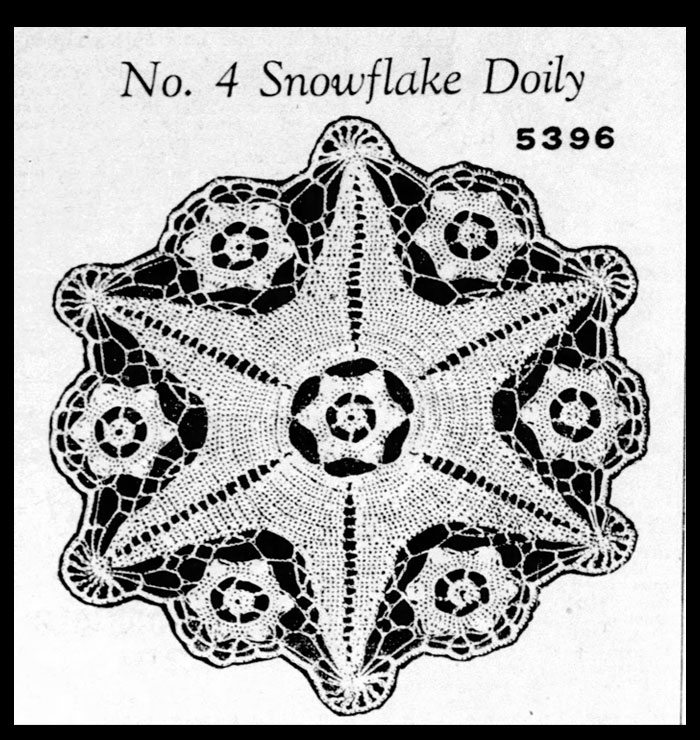
Anne Cabot 5396 - Released July 05, 1942
"This is No. 4 in my series of of six "snowflake" doilies.  Each one is exactly the same size - 9 inches in diameter.  You can make four or six of any one of the doilies - this one illustrated - for instance, or you can make one of each design. The complete set of crocheted snowflakes is indeed an unusual and lovely set.  You'll take prizes at home or at exhibitions with this beautiful heirloom piece".
Anne Cabot 5410 - Released July 31, 1942
"Here it is - the first doily in my snowflake series. There are so many uses for these lovely doilies that you'll have a wonderful time trying to decide just where in your home they look prettiest.  Each doily is just 9 inches in diameter.  Make a whole half dozen of any one of them or make your "collection" of one of each design. It will soon be county fair season - you'll certainly want to enter a Snowflake Doily - they're prize winners".
Anne Cabot 5441, Released September 24, 1942
The sixth and last in my series of "Snowflake" doilies  - each one 9 inches in diameter - each one lovelier than the other! They're really collectors doilies, though easy to crochet. Make a set of six to use as dessert plate doilies - make one of each design if you wish to have an unusual "show" or exhibition collection".

The same series was released in a number of newspapers in 1943 and a couple also appeared randomly, with different descriptions, not referencing the collectors series.

As I said, I have just two of them in my current collection.   I would, of course, like to have them all!  If you happen to have the missing 4 in your collection, would you be willing to share them?    I'll trade for other patterns!

Hope you enjoyed the series.  Thanks for dropping by,
Lorrie

Nantuk 4-Ply Knitting Worsted, Columbia Minerva

For this post, let's go back to 1964.  Columbia Minerva introduced their Nantuk 4-Ply Knitting Worsted.  
Nantuk 4-Ply Knitting Worsted
100% Orlon Acrylic - 2 oz


The yarn made it's debut in the market at 74 cents per skein.   Notice the 'Du Pont' on the advertisement?  Du Pont introduced the fibers that became the Orlon identification.   The hope was Orlon would become a replacement for wool. 


To coincide with the Nantuk 4-ply introduction, a pattern book, with 17 patterns for knit and crochet.   was released  - Afghans by Columbia Minerva

As was typical for Columbia Minerva, they also offered 'free patterns' through newspapers advertisements, where the 'reader' would send for the pattern and then, of course, purchase the yarn,
There were several of these offerings between 1967 and 1971.   The yarn was also featured in several other Columbia Minerva pattern books. 

By late 1971, the general price had risen to $1.90, with, of course, promotional sale prices varying dramatically.    This price point held for the rest of the yarns' life span.  

And then, around 1986, production stopped and through 1987, the yarn was discounted until inventories disappeared.  

Now, there are quite a number of vintage patterns that call for Nantuk 4-ply Knitting Worsted.  You'll find, of course, quite a number of them in the shop.   For a replacement yarn ... well .... any 4-ply Knitting Worsted will do.  Just do a quick check of your gauge.  

Hope you found this helpful.   Thanks for dropping by, 
Lorrie

Wednesday, June 3, 2020

Crochet Daisy Tablecloth, American Thread Pattern Promotion

American Thread Company, from the early 1940's through the 1950's, employed a number of pattern promotion techniques.   The pattern promotions were to entice the user to purchase their thread.  Along the lines of  .... love the pattern .... purchase the thread.   Patterns might be advertised as 'mail order' through magazines or newspapers, or handed out at the local 'yarn shop'. 

Here's a great example - American Thread Leaflet No 5701; a delightful Daisy Tablecloth made up of 2-1/2 inch square medallions.  (From my collection of leaflets) shows it was distributed by the Local Sewing Club with a side caption of "As near as your postman", making it an obvious mail order.   Although the leaflet references American Thread, they do not
 I must say, it is a delightful square, that would be lovely in a number of home accessories.


A search of the newspaper database brought another example in this newspaper clipping from early 1948 requesting the reader send a request to receive the pattern by Mail.  

Note the colorful description here -- rather a play on the other syndicated patterns of Alice Brooks, Anne Cabot etc. - "When friends come for tea, your lace tablecloth adds a special welcome.  Here's a lovely cloth of square motifs with daisy centers as white, informal and graceful as a field of daisies.   These lacy pieces make cool summertime needlework for crocheters".

It would be my guess that this pattern was a specific promotion for the Gem Mercerized Crochet Cotton; which American Thread introduced in January of 1948.      

If you'd like to put this one on your hook, it's available in the shop at the link above. 

Thanks for dropping by, 
Lorrie 

Monday, May 18, 2020

Angel Crepe Yarn; Bucilla, Bear Brand, Fleishers

Working my way through a lovely Bucilla pattern book - Picturesque Hats - this morning, I decided I'd take a moment to learn about one of the yarns.   In this case, Bucilla Angel Crepe.   Now, as many of you may know, Bucilla, Bear Brand and Fleishers (under the original umbrella of Bernhard Ulman).  This means, all three companies marketed this yarn.  Yep, same yarn, typically the exact same price, just different brands,  
Angel Crepe Yarn:  71%Virgin Wool and 29% Rayon.  
two 2-ply of rayon and wool plied together
Worsted weight yarn
Described as:  A lovely Angel Crepe yarn, a soft French Zephyr with a twist of rayon.   
Uses:  Dresses, blouses, accessories

The yarn was introduced in 1-oz balls in 1934, and ended in 4-oz skeins in 1953

 Bear Brand started the advertising blitz in the form of pattern offerings.   Introduce an highly desired fashion pattern free of charge and you'll buy the yarn to make it.  


Fleishers were following the same practice.   


Several months later - early 1935, the advertisements began displaying the price.   The yarn and it's pricing struggling to maintain an audience through the 1940's.   Remember, this was WWII era with times being financially tough and many women working long hours without time for dress knitting,  

Late 1940's into the 1950's, the Bernhard companies continued marketing their Angel Crepe brand, but primarily through magazines.   They would place an advertisement in the magazine, which would then publish one or two of their patterns to entice the reader to purchase.  This blouse appeared in the 1950 issue of Smart Knitting Magazine, along with a couple dresses.   I've also seen advertisements from Modern Knitting and Modern Needlecraft magazines.

 
There was also a number of pattern books issued that featured several in each of the Angel Crepe Yarn.  This book, Picturesque Hats in Hand Crochet was published under the Bernhard Ulman name in 1939

Both Bear Brands a Fleishers also went on a newspaper and magazine campaign for kits.  This advertisement for a 'Knit-a-Tie' kit, where you received the yarn and instructions for 'only $1.75'.
 
In 1953 came this advertising campaign announcing Angel Crepe is back!   Well, it had not been gone, but sales were obviously lacking.  Advertisements listing the price were were down also to the original introduction - at 50 cents for a 4-oz skein versus the 1-oz ball.   We were moving into the era of ready made quick fashions and the years of knitting one's own dress was declining.   

And then, other than secondary markets, this yarn disappeared.   Now, I can't give you exact substitutes as I don't Knit (just research), but should you fall for one of the patterns calling for Angel Crepe, look at the specs given at the top of this post and make a selection to meet the gauge of your particular 
pattern.  


Oh - one last note for some Trivia.   Why didn't other yarn manufacturers also produce Angel Crepe Yarn?   Well, the answer is ... Bernhard Ulman Trademarked it! 

Hope you enjoyed the post.   Thanks for dropping by, 
Lorrie