Search This Blog

Friday, June 5, 2020

Crochet Snowflake Doily Pattern Series, Anne Cabot

I (currently) have two Anne Cabot patterns in my collection that reference "Snowflake Series" which brought me to wondering more.   I've processed several thousand Mail Order patterns, researching each one to the extent possible, and have to say this is the first time I've seen an actual series.   It's definitely worth an hour to investigate.

The series, six patterns in all,  began in April, 1942 and continued at sporadic intervals into September 1942.  "The snowflake, brilliant white and lacy, lends itself as a perfect motif for the crochet doily pattern". Now, I'm sure the description of duplicating from a photograph under a microscope is a bit of a stretch.   But, you know, it's all about marketing!

Here's the collection.   I've duplicated the exact wording below each from the newspaper descriptions.
Anne Cabot 5351  - Released April 07, 1942
"The first in my series of snowflake doilies - done in crochet. This doily has been painstakingly copied, under a microscope from a photograph of an actual snowflake.  It's a genuine museum piece - a six inch handful of delicate loveliness! One ball of No 40 crochet cotton is all it calls for - make it in your spare time - you'll have an exhibition piece that will call forth gasps of admiration. And, a whole collection of snowflake doilies - such a collection would be a valuable heirloom!  Make this first snowflake for yourself, or use it as a most charming wedding present".
Anne Cabot 5360 - Released April 24, 1942
"Here is the second "snowflake" in the series of doilies for fans and doily collectors.  It's even lovelier that the first one - and will be a beautiful compliment to it!  Each doily is the same size - about 8-1/2 inches across. Each doily has been copied from an enlarged photograph of an actual snowflake - and, as you know, the variety of the forms of snowflakes is infinite. A collection of these rare doilies will make a most unusual exhibit. And, as decorations for the home they are unsurpassed. Use them under glass flower bowls, or the shelves of your china closet, as a deluxe present. Take just one small ball of No 40 crochet cotton".
Anne Cabot 5372 - Released May 18, 1942
"This is the third doily in my series of "snowflake" designs.  You've doubtless seen the first two - they appeared in this column a few weeks ago.  There will be at least six in the complete series - three more will appear during June and August. You'll be able to exhibit all six (if you are out to capture prizes) at your state fair in the fall. Each doily is about 9 inches across and each one has been copied from a real snowflake.  You can make as many as you like of any one design and use them as a set, or you can make one of each "snowflake" and have a glorious collection of the most unusual doilies you've ever seen".
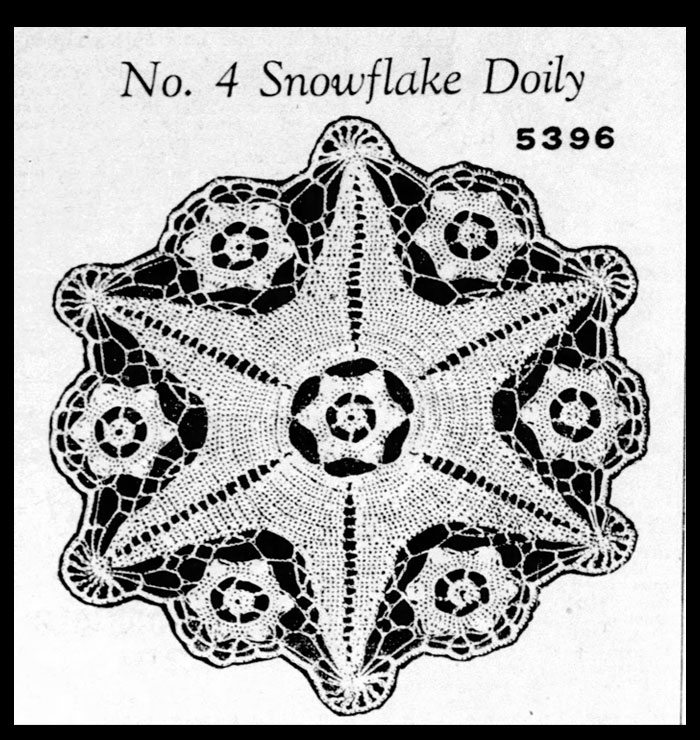
Anne Cabot 5396 - Released July 05, 1942
"This is No. 4 in my series of of six "snowflake" doilies.  Each one is exactly the same size - 9 inches in diameter.  You can make four or six of any one of the doilies - this one illustrated - for instance, or you can make one of each design. The complete set of crocheted snowflakes is indeed an unusual and lovely set.  You'll take prizes at home or at exhibitions with this beautiful heirloom piece".
Anne Cabot 5410 - Released July 31, 1942
"Here it is - the first doily in my snowflake series. There are so many uses for these lovely doilies that you'll have a wonderful time trying to decide just where in your home they look prettiest.  Each doily is just 9 inches in diameter.  Make a whole half dozen of any one of them or make your "collection" of one of each design. It will soon be county fair season - you'll certainly want to enter a Snowflake Doily - they're prize winners".
Anne Cabot 5441, Released September 24, 1942
The sixth and last in my series of "Snowflake" doilies  - each one 9 inches in diameter - each one lovelier than the other! They're really collectors doilies, though easy to crochet. Make a set of six to use as dessert plate doilies - make one of each design if you wish to have an unusual "show" or exhibition collection".

The same series was released in a number of newspapers in 1943 and a couple also appeared randomly, with different descriptions, not referencing the collectors series.

As I said, I have just two of them in my current collection.   I would, of course, like to have them all!  If you happen to have the missing 4 in your collection, would you be willing to share them?    I'll trade for other patterns!

Hope you enjoyed the series.  Thanks for dropping by,
Lorrie

Nantuk 4-Ply Knitting Worsted, Columbia Minerva

For this post, let's go back to 1964.  Columbia Minerva introduced their Nantuk 4-Ply Knitting Worsted.  
Nantuk 4-Ply Knitting Worsted
100% Orlon Acrylic - 2 oz


The yarn made it's debut in the market at 74 cents per skein.   Notice the 'Du Pont' on the advertisement?  Du Pont introduced the fibers that became the Orlon identification.   The hope was Orlon would become a replacement for wool. 


To coincide with the Nantuk 4-ply introduction, a pattern book, with 17 patterns for knit and crochet.   was released  - Afghans by Columbia Minerva

As was typical for Columbia Minerva, they also offered 'free patterns' through newspapers advertisements, where the 'reader' would send for the pattern and then, of course, purchase the yarn,
There were several of these offerings between 1967 and 1971.   The yarn was also featured in several other Columbia Minerva pattern books. 

By late 1971, the general price had risen to $1.90, with, of course, promotional sale prices varying dramatically.    This price point held for the rest of the yarns' life span.  

And then, around 1986, production stopped and through 1987, the yarn was discounted until inventories disappeared.  

Now, there are quite a number of vintage patterns that call for Nantuk 4-ply Knitting Worsted.  You'll find, of course, quite a number of them in the shop.   For a replacement yarn ... well .... any 4-ply Knitting Worsted will do.  Just do a quick check of your gauge.  

Hope you found this helpful.   Thanks for dropping by, 
Lorrie

Wednesday, June 3, 2020

Crochet Daisy Tablecloth, American Thread Pattern Promotion

American Thread Company, from the early 1940's through the 1950's, employed a number of pattern promotion techniques.   The pattern promotions were to entice the user to purchase their thread.  Along the lines of  .... love the pattern .... purchase the thread.   Patterns might be advertised as 'mail order' through magazines or newspapers, or handed out at the local 'yarn shop'. 

Here's a great example - American Thread Leaflet No 5701; a delightful Daisy Tablecloth made up of 2-1/2 inch square medallions.  (From my collection of leaflets) shows it was distributed by the Local Sewing Club with a side caption of "As near as your postman", making it an obvious mail order.   Although the leaflet references American Thread, they do not
 I must say, it is a delightful square, that would be lovely in a number of home accessories.


A search of the newspaper database brought another example in this newspaper clipping from early 1948 requesting the reader send a request to receive the pattern by Mail.  

Note the colorful description here -- rather a play on the other syndicated patterns of Alice Brooks, Anne Cabot etc. - "When friends come for tea, your lace tablecloth adds a special welcome.  Here's a lovely cloth of square motifs with daisy centers as white, informal and graceful as a field of daisies.   These lacy pieces make cool summertime needlework for crocheters".

It would be my guess that this pattern was a specific promotion for the Gem Mercerized Crochet Cotton; which American Thread introduced in January of 1948.      

If you'd like to put this one on your hook, it's available in the shop at the link above. 

Thanks for dropping by, 
Lorrie 

Monday, May 18, 2020

Angel Crepe Yarn; Bucilla, Bear Brand, Fleishers

Working my way through a lovely Bucilla pattern book - Picturesque Hats - this morning, I decided I'd take a moment to learn about one of the yarns.   In this case, Bucilla Angel Crepe.   Now, as many of you may know, Bucilla, Bear Brand and Fleishers (under the original umbrella of Bernhard Ulman).  This means, all three companies marketed this yarn.  Yep, same yarn, typically the exact same price, just different brands,  
Angel Crepe Yarn:  71%Virgin Wool and 29% Rayon.  
two 2-ply of rayon and wool plied together
Worsted weight yarn
Described as:  A lovely Angel Crepe yarn, a soft French Zephyr with a twist of rayon.   
Uses:  Dresses, blouses, accessories

The yarn was introduced in 1-oz balls in 1934, and ended in 4-oz skeins in 1953

 Bear Brand started the advertising blitz in the form of pattern offerings.   Introduce an highly desired fashion pattern free of charge and you'll buy the yarn to make it.  


Fleishers were following the same practice.   


Several months later - early 1935, the advertisements began displaying the price.   The yarn and it's pricing struggling to maintain an audience through the 1940's.   Remember, this was WWII era with times being financially tough and many women working long hours without time for dress knitting,  

Late 1940's into the 1950's, the Bernhard companies continued marketing their Angel Crepe brand, but primarily through magazines.   They would place an advertisement in the magazine, which would then publish one or two of their patterns to entice the reader to purchase.  This blouse appeared in the 1950 issue of Smart Knitting Magazine, along with a couple dresses.   I've also seen advertisements from Modern Knitting and Modern Needlecraft magazines.

 
There was also a number of pattern books issued that featured several in each of the Angel Crepe Yarn.  This book, Picturesque Hats in Hand Crochet was published under the Bernhard Ulman name in 1939

Both Bear Brands a Fleishers also went on a newspaper and magazine campaign for kits.  This advertisement for a 'Knit-a-Tie' kit, where you received the yarn and instructions for 'only $1.75'.
 
In 1953 came this advertising campaign announcing Angel Crepe is back!   Well, it had not been gone, but sales were obviously lacking.  Advertisements listing the price were were down also to the original introduction - at 50 cents for a 4-oz skein versus the 1-oz ball.   We were moving into the era of ready made quick fashions and the years of knitting one's own dress was declining.   

And then, other than secondary markets, this yarn disappeared.   Now, I can't give you exact substitutes as I don't Knit (just research), but should you fall for one of the patterns calling for Angel Crepe, look at the specs given at the top of this post and make a selection to meet the gauge of your particular 
pattern.  


Oh - one last note for some Trivia.   Why didn't other yarn manufacturers also produce Angel Crepe Yarn?   Well, the answer is ... Bernhard Ulman Trademarked it! 

Hope you enjoyed the post.   Thanks for dropping by, 
Lorrie 

Saturday, February 22, 2020

Minerva Milady Knitting Yarn

When writing a post for one of the vintage yarns, I always like to start with a picture of the yarn itself, which I can usually locate from one of the Ebay or Etsy sellers.  But, in this case - Minerva Milady Knitting Yarn, not a single picture of the actual yarn has been found.   (I have set up a Google Alert, should one appear).

What I have learned .... 
Lees Minerva introduced the brand early 1933 

This yarn was 100% wool, sold in 4-oz skeins in 40 beautiful colors -- quite a variety of colors for first introduction. 

The yarn apparently proves itself successful, gaining a full 30 cents from the introductory price of 19 cents.    The yarn was touted for suits, coats, dresses, sweaters and afghans.  Lees Minerva published a number of misses clothing / accessory patterns through the 30's, so I'd assume several included patterns calling for this yarn.  

In 1943, Lees Minerva published pattern book - Minerva Afghans - Vol 66 which featured the Milady Yarn in each pattern.  These patterns are in the shop, should you be interested in looking.  

During World War II, sale advertisements dwindled in newspapers, which leads me to assume manufacturing may have been discontinued early 1940's as wool supply to common market became scarce.   

There was a brief marketing sprint at the end of the 1940's, ending in 1951,  which I assume, was final sell-off of the product line.    The pattern featured in this advertisement is Charleston Block - a colorful classic Granny.  

And ... that's all I know.   But, should I come across other books or information about this yarn, I'll update this post.  If you should happen to know more, I'd appreciate your sharing!  

Lorrie 

Saturday, February 8, 2020

Crochet Star Medallion Pattern, Mail Order Design

Some time back I created spreadsheets to keep track of my mail order collection.  This step, although a bit time consuming, has been quite an eye opener.   I'll start posting some of these tidbits ... just in case anyone 'out there' should be interested. 

When a Mail Order pattern proved popular, it was published multiple years and/or under multiple numbers.  At each release, the pattern description would change. Lets take the example of the popular Crochet Star Medallion. 

It's an attractive hexagon medallion in star motif that will measure 3-1/2 or 5-1/2" depending upon thread. 


This Design was first released in October of 1940.  "Can't you picture a spread of this lovely crocheted medallion enhancing your bedroom. It's a beginner choice indeed for it's so easy and works up so effectively".  

And then again in March of 1941,  "Beginner's, here's crochet that will win you laurels. The easy medallion repeated makes a variety of accessories large and small, as you wish.Use string, it works up quickly.  

Design 2675, although billed as a Medallion, as portrayed as a bedspread in this picture.  Here, the same design is shown as a tablecloth. 
The pattern was released in July, 1947 - description:  "Star of all medallions! Easy to crochet, quick to memorize.  You'll love it's cobwebby beauty in a spread or cloth. Good pick-up work. The sky is the limit to the lovely accessories you can make".
Again in July, 1948, September 1948 and July 1949 - description:  "Don't wish on a star - just crochet this one instead! The accessories you long for are yours in no time with this easy medallion.  You can win prizes with this crochet at your fair".
And, one more time in 1950 - description: Star this medallion in your home. It rates applause any way you use it.  "You'll memorize it quickly, then it's pure fun to do. This is a wonderfully easy was to grace your home with heirloom luxuries"

Here, the pattern has switched over to be marketed as Alice Brooks versus Laura Wheeler.  Also billed as a tablecloth, the table setting itself changed. 
This Design version was released in June 1956, March 1957 - description: "You'll win prizes with this quick crochet medallion.  It lends itself to both fine cotton and string.  Make small articles or plan a bedspread or tablecloth".
Again in December 1958, February 1959, February 1960 and May 1961 - Description: This prize medallion is especially good for large and small articles: scarves, mats, pillows, bedspreads.  A quick, thrift way to acquire lovely accessories",

Now, I've found one other occurrence of this exact pattern under the name of American Weekly.

Patterns branded American Weekly appeared only in the Sunday weekly circular of the same name.  I do not (currently) know the relationship between The American Weekly and Needlecraft Services, but assume advertising space was purchased and the pattern was simply branded.    I (currently) have no way to date the publications of these patterns.  

Are their more occurrences where this pattern was marketed under different numbers and descriptions?  Possible.   These are simple the patterns that I've purchased, processed and am aware of.   Should I discover more, I'll update this post.  

It's obvious this was a popular, and well selling design.  And, for very apparent reasons - it's a quite lovely medallion.    Should you be interested in the pattern, it is available in my shop - links under pattern pictures.  I've been asked, if a pattern is the same, why do I list it multiple times.   That's a very easy answer.   Sometimes one might be searching for a pattern of a specific number.

Well, I imagine, if you've made it to here, you've read enough about this particular pattern and I'll move on to something else!

Sunday, January 26, 2020

Crochet Hot Plate Mats, Asbestos Replacement

I'm processing a Free Download for the shop this afternoon for a crocheted hot plate mat from 1949.


Of course, I've seen the material requirement before, but had never put much thought into it .... 8-1/2 inch Asbestos Mat.   Now, I have a few of these mat patterns in the shop, which have never sold, which made we wonder if these have lost their vintage interest because of these Asbestos Mats.

Asbestos Mats made their appearance back in the 1890's.


These mats were made in two parts - the mat itself being a sturdy cardboard with the top layer being an asbestos layer called Millboard.  Asbestos was fireproof and absorbed heat, making it an asset for cooking.  Remember, cooking in the late 1800's was a quite rustic affair.  

As we moved into the 1920/30's, many homes now had kitchen stoves with burners which allowed these mats to become more decorative.  What woman didn't want a more decorative kitchen!  Initially, decorative covers were made using macrame cords, but then moved towards the influx of colorful crochet cottons.


Patterns for these mats began appearing in newspapers in 1935; first offerings being from the Women's Service Bureau, quickly followed by the Mail Order companies and, of course, the promotional pattern books and leaflets of the thread manufacturers.

Asbestos mats soon evolved to meet many household - heat conducive - needs.  The product was found, not only in mats and table pads, but our appliances, insulation and so much more. 

Asbestos use continued into the 1970's, when it was determined to be a carcinogen and removed from the marketplace. 

Well, let's get me back on focus here .... these vintage hot plate cover patterns that call for the asbestos mats.   You can use the covers without the mat insert; many mats pattern do not call for it.


 Or, if you need a heat buffer to put hot pots on your tables, there's a great substitute in the form of Pellon.  This particular interfacing - Pellon 975 - will function well, as will a number of others interfacing you'll find in your sewing shops.    Just cut the interfacing to your desired size.  The primary different between interfacing substitutes and the obsolete asbestos mats is the sturdy factor.

So, should you be partial to the particular design of a hot plate mat cover, don't discount your creativity over the asbestos mat. 

Okay, I've now killed an hour .... time to get back to work!

Thanks for dropping by.