Search This Blog

Wednesday, January 10, 2018

Hiawatha Super Chenille Yarn

The Heirloom Needlecraft Guild copyrighted their Chenille yarn in May, 1944. 

Their are basically two brands here ... Chenille and Super Chenille ... with the different being how many yards per skein.  (Chenille has 36 yards, with Super Chenille having 72). 
 

Pictures courtesy of Etsy Seller AnniesAntiques

Hiawatha Super Chenille, Art 66 (wired):  80% Rayon, 20% Cotton
Crochet Gauge Reference:  7 sts = 2"; 6 rows = 2"  
Crochet Hook 00

 By early 1945, the yarn had been distributed to yarn shops and was being advertised in newspapers.


Both these advertisements were at product introduction, with the 36 yard skeins selling (on average) at 65 cents.  This soft and luxurious yarn is marketed primarily for fashion accessories.   


This advertisement, mid 1952, shows that the price was on the decline, even with the quantity being doubled!.   By 1955, the product was no longer available.   

There are a number of patterns calling for this yarn in the shop, should you care to browse.   Many of these are well worth another fashion shot.   To use, select a wired chenille that will get you close to the gauge noted above (or in the specific pattern).   

Thanks for dropping by,

Sunday, January 7, 2018

Hiawatha Belastraw, Article 35

I volunteer at a local Thrift Shop on Thursday.   Last week I was walking through, and on the top of an incoming box, I saw it ....
Hiawatha Belastraw.   I'm sure others may have heard the screeching sound as I made an immediate U-turn to claim this sole tube.   (There were a couple other goodies in there that I'll cover later).   I've a number of patterns in the shop that call for Hiawatha Belastraw and always like to give the details for these vintage threads. 

Hiawatha Belastraw, Article 35- 100 Viscose Process Rayon thread, 6 ply.    Now, just for conversation sake, Dritz and Bernat also marketed a Belastraw product with the only difference being they are 5 ply, versus the 6 ply.

Here's the close-up.   I've always seen it described as straw-like.   Now, it is heavier than a heavy thread, but it's not nearly as stiff as a 'straw'.   I happened to have a ball of thin soft twine in my studio, and felt they were very similar.   I'd suggest, if looking for a replacement, you give twine, or perhaps jute a try to match the gauges given.  

Hiawatha Belastraw entered the market in 1945.   This was the WWII era, when wool was dedicated to military production and yarn/thread suppliers had to develop substitute materials.   Thus, rayons and other synthetics became a mainstream.  The introductory price ... $0.59/tube.  

The product was heavily marketed in newspapers across the country.   Often the individual yarn shops offered free instruction as well. 

And, of course, a number of pattern books were published to not only drive up demand for the product, but to fill a need for those wanting to create accessories in the 'wool-less' time.

Hiawatha Belastraw remained strong in the market through 1953 and then started to fade, completing disappearing from 'advertisements' in 1957. 

Of course, rayon and synthetic blends, combined into cottons and wools were bounding and like all trends, the fiber artists were 'moving on' to other options.  But, from this era, there remain a large number of fabulous vintage patterns (from Hiawatha, Dritz and Bernat) that deserve going forward.   If you love vintage fashions, I'd suggest giving them a ry. 

OH ... and please, when you find a substitute that works well for you, please drop back by and let's us know.
Lorrie

Saturday, January 6, 2018

Womans Day Mail Order Crochet Patterns

A LOT OF CROCHET with a little thread  For this post, let's go all the way back to a 1945 issue of Woman's Day magazine. Tucked inside the magazine are four pages of pattern promotions that required the reader to send away for the patterns. Woman's Day did not charge for the Mail Order, other than the reader having to include a 3 cent stamp with the request. I've been lucky to find a couple of these sets in my sleuthing.
These patterns were offered as a Coats and Clark's thread promotion; all requiring Mercerized Crochet Cotton, or Tatting Cotton, etc.
This is the copy of the original magazine pages. I've included parts of the text for the patterns as their descriptions are quite delightful and I thought it may be easier to read than off the picture. Have fun looking at those 1945 "prices to make".
Pattern 1 is a jabot collar:  A white froth of a fish-net jabot with buttonholes in the center to button over your favorite blouse, or to wear as a ruff around the neck. The finer the thread, the prettier it is. Cost to make 20 cents


Pattern 2 offers up three attractive trims. Three lovely laces to add lighthearted touches to any frock. Use one as a prim collar on a tailored dress, or add a crisp touch to a pocket and a demure square neckline. Accentuate the shoulder lines of a summer cotton with a frosty ruffle. And nothing can look quite so romantic as, a spun-sugar frill cascading down the front of your special-occasions dress. This pattern is available in the shop as a Free Download.
Red and Black Bag: Plenty of room for everything in this large shoulder-strap bag with its extra saddle pocket on each side. Cost to make it in red and black rug yarn, $1.50

Red Bag:  We think big bags are the most useful kind. This one in bright red rug yarn with zipper closing adds a bright note to your costume. Cost to make, $1.25
6 - A chubby pink yarn sacque and matching bonnet for baby in an interesting new stitch. Cost to crochet in wool, about $1.25
7 - Crochet a little girl's skirt and give it firm anchorage with these practical, wide-shouldered suspenders. This one is in sturdy tan wool, with blue stripes, and the tam o'shanter is designed to match. Cost to make, $1.45
8 - Jaunty is the word for this cap, and a welcome change from those under-the-chin bows. Crochet it loosely in wool, 29 cents

Pattern 3 - Sweater:  We selected the smart, practical sweater shown on the opposite page, hoping that everyone would have yarn remnants on hand in several colors. This one is made in gray, brown and black wool. The style has many useful features—it is boxy and bulky enough to use as a jacket for cool summer weather, or with its drawstring waistline bloused, it is perfect over a wool skirt for fall. The close, interesting stitch resembles hand weaving. Cost to make in new wool, $3.50
9. Light and comfortable, a neat little hat made of spun straw. Cost to make. about 50 cents
10. Crochet a fuchsia hat of spun straw and perch shocking-pink flowers on the top to wear for dress-up occasions all summer. Cost to make, about $1.00

11. Filet Teacloth: You may not find enough thread to make the fillet corners of this sparkling tea cloth, but the rose-wreath pattern is one you will want to save for after the war. With a linen center it costs $5.20 to make.
12. Fillet insertion with ribbon design for household linens. Crochet enough for a pillowcase for only 20 cents
13. Plain insertion looks so expensive. Substitute it for worn hemstitching on a pillowcase. To do one, 20 cents.
14. White Doily: Clusters and lacy shells combine in the delicate pattern of this doily. Cost to make one, 10 cents
15. White Doily II: An assortment of stitches make this eight-pointed star design varied and interesting. Cost to make one 10 cents.
16. A formalized dahlia design enhances the center of this fillet doily. To crochet one costs 20 cents
17. Wide insertion in a wild-rose pat tern to keep in mind for our new post war sheets. Enough for one, 8o cent
18. A pointed fillet edging with bow knot design, to give old-fashioned luxury to a sheet. To make, 60 cents
19. Plain crochet mesh adds a dainty touch to a baby's pillowcase. Use a pastel lining. To crochet, 10 cents
And that's the entire pamphlet set. There's a number of nice designs here. I've entered a number of the patterns to the shop; as designated by the links. If you must have one of the others, let me know and I'll see what I can do. Some of the patterns had too poor picture quality to work with.
Thanks for dropping by,
Lorrie

Thursday, December 28, 2017

Spinnerin Coquette Yarn

Coquette = A woman who endeavors without sincere affection to gain the attention and admiration of men. 

Spinnerin introduced their Coquette Yarn in 1948.   It was post war time, beginning of the baby boomer generation, and the ladies were hungry for 'that something pretty' and this lightweight nubby yarn was one that fit the bill.  

At introduction the yarn was 100% Virgin Wool in 1-oz skeins. 


In the mid 1950's the brand was changed to 96% Virgin Wool and 4% Nylon.  Also note the change of the Spinnerin label to a 'more modern' look.  This is a thin 2-strand nubby yarn woven into the crinkly texture.   It is specifically designed for dress making.   More details can be found at Ravelry.


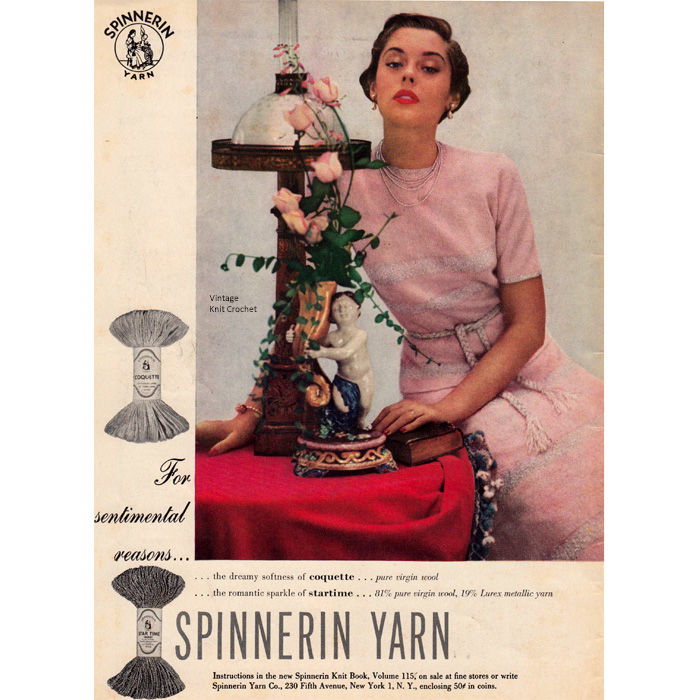
"For sentimental reasons ... the dreamy softness of Coquette".  This 1950 full page magazine advertisement  was a dual promotion with Spinnerin Startime; also a dress yarn.  

"Go everywhere classic boucle yarn with the smoother texture and the longer wear blended right into every lovely inch of your dress or blouse".   This 1952 advertisement is the first promotion I've found from newspaper sources.  

"Coquette - the Queen of dress yarns ... pure virgin wool".  This full page magazine promotion takes us back to 1952 and promotes an interesting twist -- a mail-away dress and bolero pattern.  

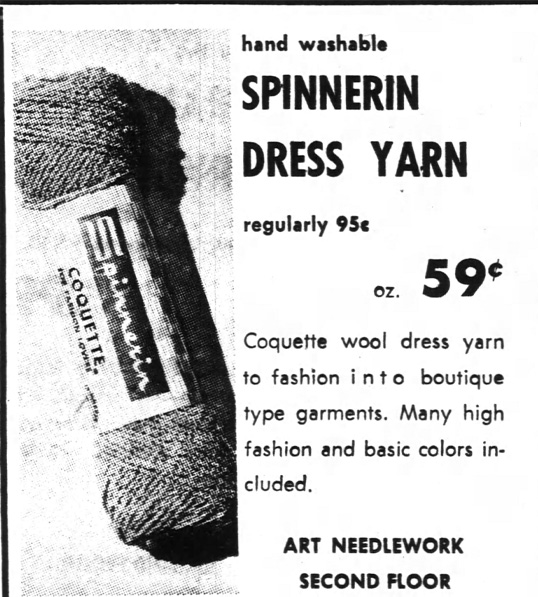
The yarn was frequently advertised by retail sellers into the early 1960's, when it began it's market decline.   In this 1963 advertisement we see the 'sale' price drop all the way down to 59 cents.   Also note that the regular price has dropped to $0.95 ... a $0.03 price drop from introduction (not to mention price of living differences).   

There are a fair amount of nice dress patterns out there that are still applicable today. There are a few available in the shop.   Just select yourself a substitute and knit on ....    Oh, and if you don't mind, add a note to let 'us all' know what you've used.    

Thanks for dropping by.  

Sunday, December 24, 2017

Bernat Cuddlespun Yarn

In 1954, Bernat added to their product line with their Cuddlespun 50/50 yarn. 

Just think of it, you can use Bernat 50/50 Cuddlespun for all kinds of stunning and colorful "Jumbo Knit" fashions .... washes up quickly ... dries like a breeze and it won't stretch, shrink or fade.  It's just as soft as it looks and and yet it's three times as strong.  

The 2-oz skeins in 17 colors premiered at $0.85/skein.   


 Individual stores selling the Cuddlespun yarn advertised frequently through the mid-1960's, as one would expect in the start of the big needle and bulky sweater phase.  

Bernat also ran full page ads in several of the popular needlecraft magazines.  


Bernat - Bulky Knits for Girls and Boys, Book No 68 was issued as the primary promotion.   The yarn also appeared in other Bernat pattern books and magazine publications into the 1960's. 

In the 1970's, the yarn fizzled out and was discontinued.    I'm sure I'll find other ads and information as I go through materials and will come back and update this post should there be anything interesting. 

And, do I have patterns that call for this yarn?   Of course I do have quite a few in the shop.  

Thanks for dropping by,

Thursday, December 21, 2017

Reynolds Danskyarn

Reynolds Danskyarn, a Danish import, was brought to the market in early 1964.   It was an additional 'bulky' yarn for the Reynolds collection.

As is apparent in this promotion, the yarn was aimed towards the sweater and hat market and came in a wide variety of colors.  (Unfortunately, when I scanned this, I did not capture the bottom of the page, however did find over on an Ebay Page).   When I have this magazine out again, I'll update my photo).
Yarn photo courtesy of Ebay Seller Gretl3042.  

Sporty Designs for the entire family are in Reynolds Volume 42, only $1.00 at needlework counters and yarn shops.  The pattern was issued as the primary promotion for Danskyarn.   The yarn did make an appearance in a number of other Reynolds pattern books as well. 


The yarn had a moment of fame when a sweater knit in the yarn was awarded first place in the 1965 National Wool Needlework Contest.   The true fame, of course, went to Shirley Braxton.

The product remained active in the market until 1974 and then was discontinued.    Now, I have no doubt I'll find more about Danskyarn (there are quite a few magazines awaiting review), and when I do, I'll come back and update this post.   And, there are a couple patterns in the shop, should you want to look. 

Thanks for dropping by.

Wednesday, December 20, 2017

Leeward's Nylon Thread, Lustra

It's the end of WWII and there are, of course, large amounts of materials available that were used in 'war production' is now surplus.   As in the case of this 1948 ad from The Workbasket magazine.


There certainly was no need to produce parachutes in mass quantity!   So, the excess materials were salvaged and it appears the Leeward scooped this up.   "Dupont Nylon Thread -- "perfect for crocheting"  -- a great fit for the Leeward craft market.    This ad, as well as a similar rendition displayed in a variety of places through 1948 and early 1949.    


The product, in the Leewards market, was apparently a success as they gave the product an official name -- LUSTRA -- and broadened the offering to different weight threads and cords.


  I'm not going further here (at this time), as there is a wonderful post over at Illinois Quilt History about Leeward Mills and this product line that I would never outdo  (It's a great read).    As I find further ads I'll come back and update this post.
Update - April 6, 2018 :  I've just finished processing a Leeward Mills pattern leaflet, which calls from Nylon thread, size 5 and size 30.   It's reviewed in a blog post at Shoptalk, should you be interested. 

Thanks for dropping by,